
"Living by the Rule"
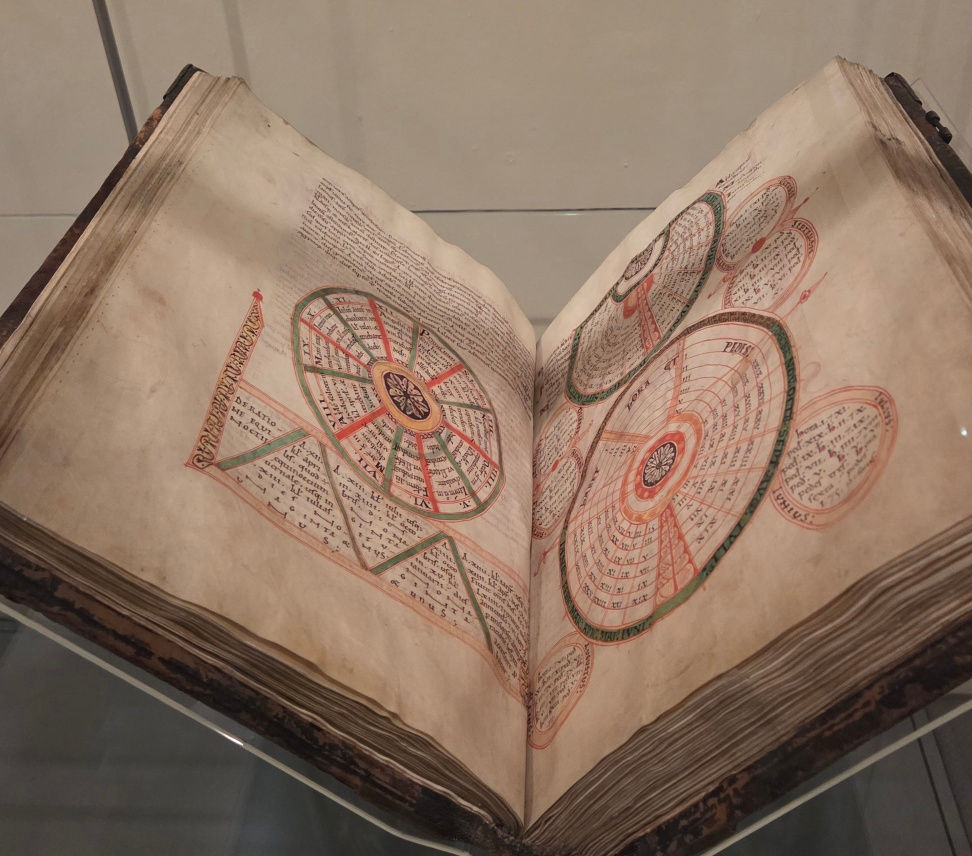
Many readers will know that Thorney Abbey was not just a complex of large stone buildings in the medieval period but was also famous for its Scriptorium. In this workshop of scribes, the monks worked to copy out religious books, and also other learned manuscripts. One of those which survives is known as the Thorney Computus. It was made in Thorney, probably around 1110.
Until 4th October 2026, it has been lent to an exhibition "Living by the Rule" at the Sainsbury Centre, University of East Anglia Norwich. Yesterday, I and another Thorney Society member visited the exhibition and we found it very interesting.
This is the Thorney Computus, and I have copied the label to show you why it was chosen for display.

The exhibition as a whole shows ancient and also modern works of art. The contrast between a medieval monk's life and that of modern artists is really interesting - particularly artworks made based on data from a woman artist's daily activity over three years (Susan Morris Living by the Rule: Contemporary Meets Medieval (2026) — SUSAN MORRIS) .
It was good to see Thorney take its place in a collection of Benedictine monasteries, all living according to the Rule of St Benedict. Other abbeys represented in the exhibition include the Priory at Norwich, now Norwich Cathedral, and Christ Church Canterbury. The carvings below were excavated from what had probably been a fountain house, a source of water for the monastic community. They are beautifully decorative, and contrast with one of Britain's earliest plumbing diagrams, which showed how water and sewage were managed in Canterbury. The heads were carved in Caen stone, from France, by unknown scuptors around 1160-70.


A visit to this exhibition is recommended, especially if you are already going to be near Norwich! Parking is free, and entry is "Pay as much as you would like". We had a very interesting free tour from a volunteer called Dave and tours run twice a day - please contact the Gallery to check times.
Dorothy Halfhide Curator
Thorney Museum


Comments